Legal CRM API Integration for Operational Reliability
Executive Summary
Legal CRM API integration should make a law firm easier to run, not create another system that staff must constantly monitor. When API authentication fails, matter updates, document workflows, and connected automations can be interrupted, leaving employees to handle tasks manually.
When integrations fail, the consequences extend beyond technical inconvenience. Matter information may stop updating, document workflows can be interrupted, and staff may have to intervene manually to keep everyday operations moving.
AZ Technologies LLC worked on a legal CRM integration engagement involving recurring authentication and automation failures in workflows connected to Lawcus. The challenge was to investigate the underlying API limitations and develop a more reliable approach to connecting the CRM with external automation platforms.
The engagement included API troubleshooting, authentication analysis, middleware development, and testing of a controlled integration approach designed to reduce dependence on fragile native connectors.
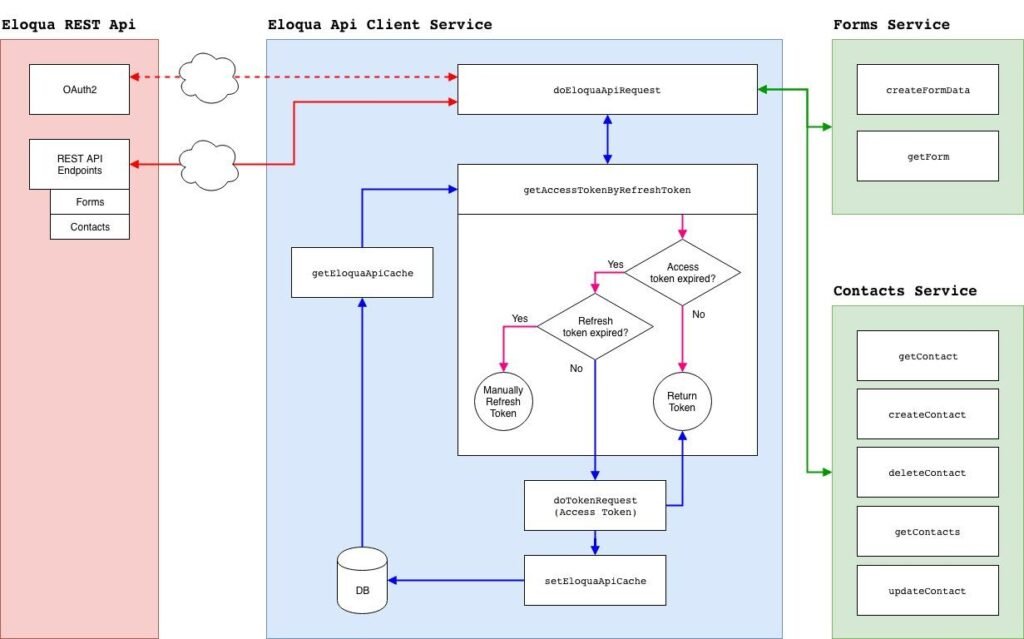
Simplified middleware architecture illustrating the integration approach
Legal CRM API Integration: The Challenge
Law firms increasingly rely on connected applications to manage client intake, matters, documents, communications, and internal tasks.
Platforms such as Lawcus offer valuable case management capabilities, but connecting them with external applications can introduce technical challenges, particularly when integrations depend on short-lived authentication tokens or third-party automation services.
In this engagement, recurring authentication issues were interrupting automated workflows and creating a need for repeated technical intervention.
The key challenges included:
- Expiring API credentials: Authentication tokens had limited lifespans, interrupting workflows that required continuous CRM access.
- Unreliable automation connections: Existing integrations required ongoing attention when authentication failed.
- Limited control over native connectors: Third-party automation tools did not provide sufficient flexibility to manage every aspect of authentication.
- Operational dependency: Business processes relying on CRM connectivity were vulnerable to integration interruptions.
The underlying issue was not simply a broken automation. It was the need for a more dependable way to manage access to the CRM’s API.
AZ Technologies’ Approach
Rather than continuing to troubleshoot individual automations, AZ Technologies investigated the API authentication process and evaluated how a dedicated integration layer could address the underlying problem.
The objective was to create a more controlled connection between the legal CRM and the applications that depended on its data.
1. API and Authentication Assessment
The first step was to examine how the CRM handled authentication, access tokens, and token expiration.
This included reviewing the behavior of existing integrations, identifying where authentication failures occurred, and testing API access outside the constraints of the native automation connectors.
This assessment helped distinguish between issues caused by individual automation workflows and limitations in how API authentication was being managed.
2. Custom Middleware Development
AZ Technologies developed and tested a PHP-based middleware endpoint to provide a controlled interface with the Lawcus API.
The approach was designed to separate authentication management from the applications and automations consuming CRM data.
The middleware work included:
- Establishing authenticated communication with the legal CRM API
- Testing token refresh functionality
- Developing endpoints to access CRM information
- Supporting API operations involving matters, leads, and contacts
- Evaluating how external workflows could communicate through an intermediary service
By placing a dedicated integration layer between the CRM and downstream applications, the architecture offered a way to manage authentication independently of individual automation workflows.
This approach reflects the work covered by our Systems Integration & API Architecture consulting services, which help businesses connect SaaS applications, develop middleware, and address complex API integration challenges.
3. Integration Testing and Validation
The middleware approach was tested against CRM API functionality to evaluate authentication behavior and access to relevant records.
This work helped establish whether a custom integration layer could provide a more suitable foundation than relying entirely on native third-party connectors.
The engagement focused on identifying a technically viable integration approach and informing the client’s broader platform decisions.
The Solution Architecture: A More Controlled Integration Layer
One of the main architectural considerations was where authentication and API communication should be managed.
In a typical direct integration, each connected application may depend on its own access to the CRM’s authentication process. When credentials expire or connector functionality is limited, individual workflows can become difficult to maintain.
A middleware-based architecture provides an alternative:
Legal CRM → Custom API Middleware → Business Applications and Automation Workflows
The middleware acts as a controlled intermediary between the CRM and connected systems.
This approach can support:
- Centralized authentication: Manage CRM access and token renewal through a dedicated integration component.
- Consistent API access: Provide structured endpoints for external workflows that need CRM information.
- Reduced connector dependency: Avoid relying exclusively on the capabilities of individual third-party connectors.
- Easier troubleshooting: Separate API authentication problems from errors in downstream business workflows.
- Future integration flexibility: Create a foundation that can be extended as application requirements change.
The appropriate architecture depends on the CRM platform, its API capabilities, the business workflows involved, and the organization’s security requirements.
Connecting Legal CRM Data With Document Workflows
API reliability becomes particularly important when legal case management data needs to connect with document management and collaboration systems.
For example, law firms may need to create matter-specific folders, associate documents with CRM records, synchronize metadata, or trigger notifications when information changes.
Microsoft 365 and OneDrive are common components of these environments. Our Microsoft 365 & SharePoint Solutions service addresses related needs involving document management, collaboration, access permissions, and workflow integration.
A well-structured integration can help support workflows such as:
- Creating document folders when new matters are opened
- Associating CRM matter references with stored documents
- Routing documents for review or internal processing
- Coordinating updates between case management and document systems
- Reducing repetitive data entry across applications
These are representative applications of the integration architecture, rather than claims that every workflow was deployed during this engagement.
Results: Technical Validation and a Clearer Integration Strategy
The engagement produced several important technical deliverables:
- Authentication issues investigated: The recurring API token and connector limitations were examined to identify the source of the workflow interruptions.
- Custom middleware developed: A PHP-based integration endpoint was created as an alternative approach to accessing the legal CRM API.
- Token management tested: Authentication and token refresh functionality were evaluated through the middleware implementation.
- CRM API operations tested: Functionality involving matters, leads, and contacts was explored through the custom integration layer.
- Technical options clarified: The work provided a clearer understanding of the available integration approaches and their implications for future platform decisions.
The outcome was a tested technical approach and a more informed integration strategy, rather than a claimed production-wide elimination of automation failures.
For legal operations teams, this distinction matters. Understanding the underlying technical constraints is essential before investing further in automations, middleware, or a broader platform migration.
Is Your Legal CRM Causing Integration Problems?
Recurring authentication failures, broken workflows, and disconnected applications can consume time that your team should be spending on clients and casework.
AZ Technologies helps businesses investigate API integration problems, design more reliable system connections, and develop practical automation solutions.
Whether you’re working with a legal CRM, document management platform, or a combination of SaaS applications, we can help you evaluate the problem and identify an appropriate technical approach.
Book a Consultation or send us your project requirements.
What Law Firms Should Consider Before Expanding CRM Automation
The technical lessons from this engagement apply to more than one legal CRM platform.
Before introducing additional automations, law firms should consider several questions:
Can the integration maintain reliable API access?
Automations that depend on expiring credentials need an appropriate authentication and renewal strategy.
What happens when a workflow fails?
An integration should provide sufficient visibility for technical staff to identify failures, investigate errors, and recover interrupted operations.
Are native connectors sufficient?
Built-in integrations can be effective for straightforward workflows. More complex requirements may benefit from custom APIs or middleware.
How will the system evolve?
As a firm’s processes change, its integrations should be designed with maintenance, security, and future platform decisions in mind.
These considerations help organizations avoid investing in increasingly complicated automations without addressing the underlying architecture.
How AZ Technologies Can Help
AZ Technologies supports law firms and other professional services organizations with technical consulting and implementation across:
- Legal CRM and SaaS API integration
- Custom middleware and authentication workflows
- AI & Workflow Automation using Zapier, Make, Power Automate, and n8n
- Microsoft 365 and document management workflows
- Business process and workflow automation
- Systems integration planning and troubleshooting
Our focus is on understanding how the business operates, identifying where systems are creating unnecessary friction, and developing technical solutions that fit the workflow.
Have a similar challenge? Contact AZ Technologies to discuss your project.