Executive Summary
Building a marketplace involves considerably more than creating a website where products or services can be listed.
A successful multi-vendor platform needs to connect different types of users, support transactions, manage interactions, and coordinate the workflows that turn an inquiry into a completed order.
Multi-vendor marketplace development becomes particularly complex when customers need customized services rather than standardized products.
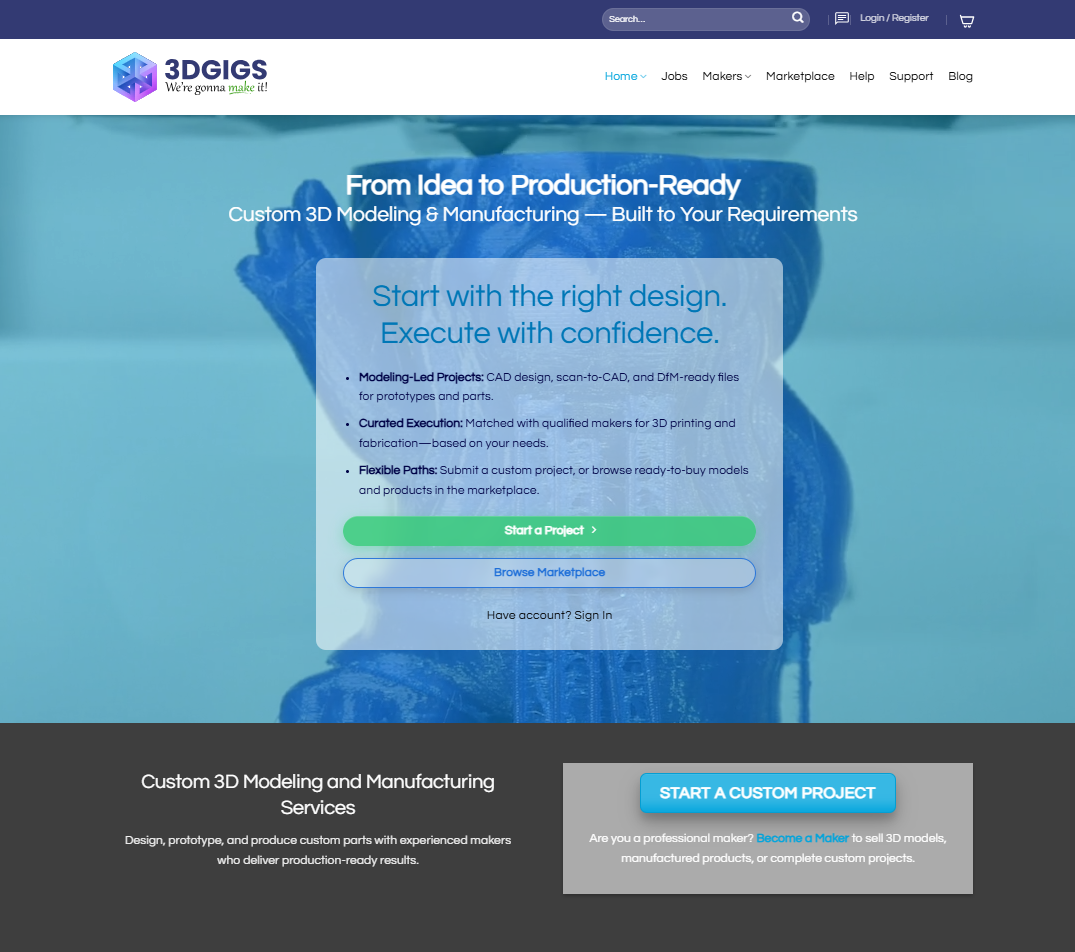
AZ Technologies developed 3DGigs, a specialized marketplace connecting customers with independent providers of 3D modeling, CAD design, prototyping, 3D printing, and custom manufacturing services.
Unlike a conventional ecommerce store, the platform needed to support two distinct purchasing journeys: customers requesting custom work from makers, and customers purchasing existing digital or physical products directly from the marketplace.
The resulting platform combines custom project submissions, maker profiles, proposals, buyer–seller communication, marketplace listings, order processing, and integrated payment workflows within a unified web platform.
This case study demonstrates how business requirements, platform architecture, ecommerce capabilities, and custom development can come together to create a working multi-vendor marketplace.
The Challenge: Building More Than a Conventional Online Store
Most ecommerce platforms are designed around a relatively straightforward transaction: a customer selects a product, adds it to a cart, pays, and receives the order.
A specialized services marketplace works differently.
A customer may have an idea for a product but need help creating a 3D model. Another may already have a CAD file and need a manufacturer to produce a physical part. A third may simply want to purchase an existing design or ready-made product.
Each scenario requires a different interaction between the buyer and the service provider.
The platform therefore needed to address several challenges:
- Two distinct user groups: Buyers and independent makers required different registration experiences, permissions, dashboards, and actions.
- Custom project requirements: Buyers needed a structured way to describe work that could not be purchased through a standard product listing.
- Proposal-based transactions: Makers needed the ability to respond with project-specific pricing, scope, and delivery terms.
- Buyer–maker communication: Both parties needed a way to discuss requirements before proceeding.
- Marketplace commerce: The platform also needed to support direct purchases of existing digital and physical products.
- Payment and order management: Custom agreements had to connect with a practical checkout and transaction process.
- Operational oversight: Marketplace administrators needed visibility into platform activity, orders, and vendor operations.
The primary challenge was connecting these individual capabilities into a coherent user experience.
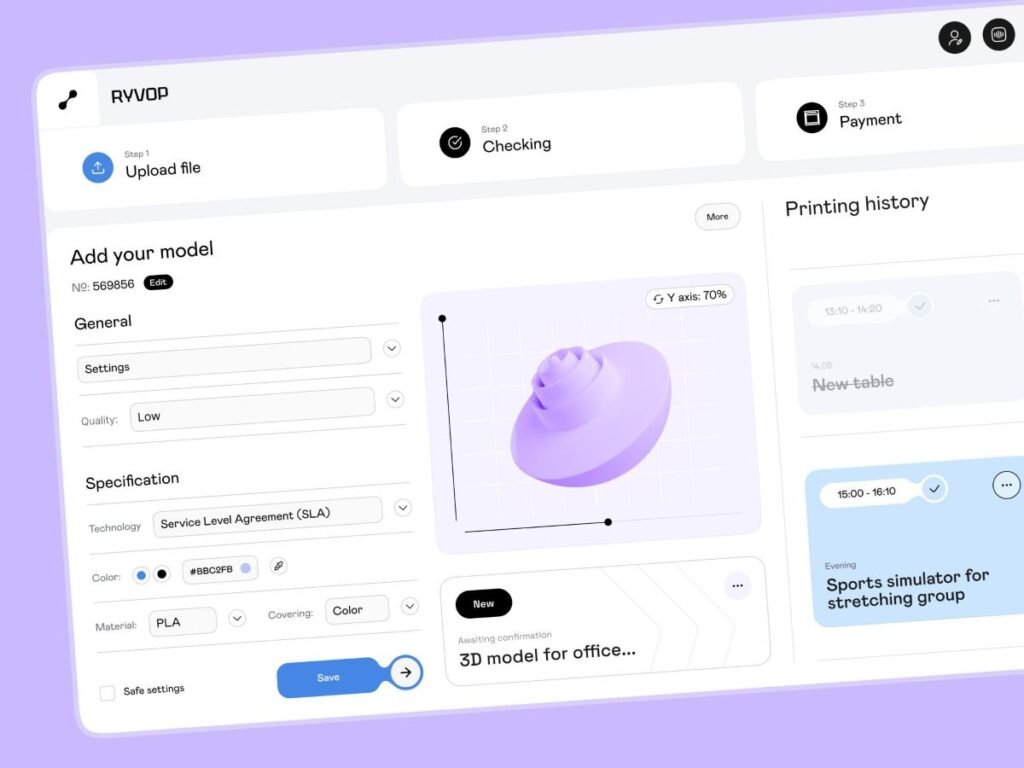
Conceptual illustration of a custom 3D printing interface; not a screenshot of 3DGigs.
AZ Technologies’ Development Approach
AZ Technologies approached the platform as a collection of interconnected business workflows rather than a conventional website development project.
The first priority was to understand how buyers and makers would interact, what information each user needed, and how a request could progress from initial submission to payment and fulfillment.
The development approach focused on a usable foundation, with custom functionality introduced where conventional ecommerce behavior did not adequately support the marketplace model.
1. Designing Separate Buyer and Maker Experiences
One of the first architectural requirements was supporting two distinct types of users.
Buyers needed the ability to:
- Submit custom project requests
- Review responses from makers
- Communicate about scope, pricing, and delivery
- Browse maker profiles and marketplace products
- Place orders and manage purchases
Makers needed capabilities to:
- Create and manage their marketplace presence
- Display their products and services
- Discover relevant custom project opportunities
- Submit proposals for customer requests
- Communicate with prospective buyers
- Manage orders and fulfillment activities
The platform was structured around these separate user journeys while connecting them through shared project and transaction workflows.
This type of role-based architecture is a key consideration in SaaS MVP and marketplace platform development, particularly when a product serves more than one audience.
2. Building a Custom Project Request and Proposal Workflow
A central feature of 3DGigs is its ability to support work that cannot be priced through a conventional product catalog.
Customers can submit a custom project request describing the work they need, whether that involves creating a 3D model, modifying an existing design, or producing a physical item.
The project workflow enables makers to review opportunities and respond with proposals based on the requirements.
This creates a structured journey:
Project Request → Maker Proposal → Buyer Review → Scope Discussion → Purchase → Delivery
Important capabilities include:
- Capturing project requirements and supporting information
- Associating proposals with individual makers and requests
- Presenting project-specific pricing and delivery considerations
- Supporting communication and negotiation
- Allowing buyers to proceed with an accepted proposal
- Connecting accepted work to the platform’s ordering process
The result is a marketplace experience designed around the actual steps required to commission custom work.
3. Connecting Custom Proposals to Ecommerce Checkout
A particularly important technical challenge was bridging the gap between a negotiated service agreement and an ecommerce transaction.
Standard online shopping assumes that product prices and specifications are established before a customer reaches checkout.
Custom service projects do not always work that way.
A maker may need to review the requirements, estimate the effort, consider delivery costs, and agree on the final scope before the customer can pay.
3DGigs was developed to support this transition from an agreed proposal to a purchasable order.
The platform connects project-specific terms with the underlying ecommerce process so that a custom request can progress into a transaction without requiring the customer to start over.
This integration brings together custom business logic, marketplace user permissions, order management, and payment processing.
It demonstrates why effective marketplace development often requires capabilities beyond configuring a standard ecommerce storefront.
4. Developing Marketplace Listings and Vendor Storefronts
In addition to custom project requests, the platform supports direct purchases through a dedicated 3DGigs Marketplace.
Makers can offer digital 3D models and physical products, giving customers an alternative to commissioning new work.
The marketplace includes capabilities for:
- Product listings and categorization
- Maker profiles and storefronts
- Digital and physical product offerings
- Product discovery and browsing
- Customer checkout
- Order and fulfillment management
Supporting both custom services and conventional product purchases within the same platform creates additional complexity.
Different transaction types require different information, fulfillment rules, and buyer expectations. The platform needed to accommodate these differences without creating completely disconnected systems.
5. Integrating Payments, Orders, and Marketplace Operations
A marketplace must do more than facilitate introductions between buyers and sellers. It also needs a practical process for handling commercial transactions.
3DGigs incorporates ecommerce checkout and Stripe payment functionality alongside marketplace-specific order and vendor workflows.
The development work addressed how transactions relate to buyers, makers, products, and custom projects.
Key considerations included:
- Connecting checkout with the correct marketplace order
- Handling digital and physical product transactions
- Supporting custom project purchasing
- Managing vendor-related order information
- Accounting for platform commissions and vendor earnings
- Supporting order and delivery workflows
- Providing operational visibility for marketplace administration
These workflows required attention to both the customer-facing experience and the underlying business processes.
Similar challenges appear in service marketplaces, booking platforms, subscription businesses, and other web applications that need to connect custom operations with payment systems.
6. Extending the Platform With Custom Development
The marketplace was built using a WordPress and WooCommerce foundation, supplemented by custom functionality to support its specialized workflows.
Rather than recreating every standard ecommerce capability from scratch, the development approach combined an established commerce platform with tailored marketplace features.
Custom development was used to address requirements such as proposal handling, buyer–maker interactions, and the connection between custom project workflows and orders.
The broader implementation required coordination between user interfaces, application logic, integrations, permissions, and transactional processes.
This illustrates a practical product engineering principle:
Use existing technology where it provides a reliable foundation, and invest in custom development where the business model genuinely requires it.
The Platform Architecture: Connecting the Marketplace Journey
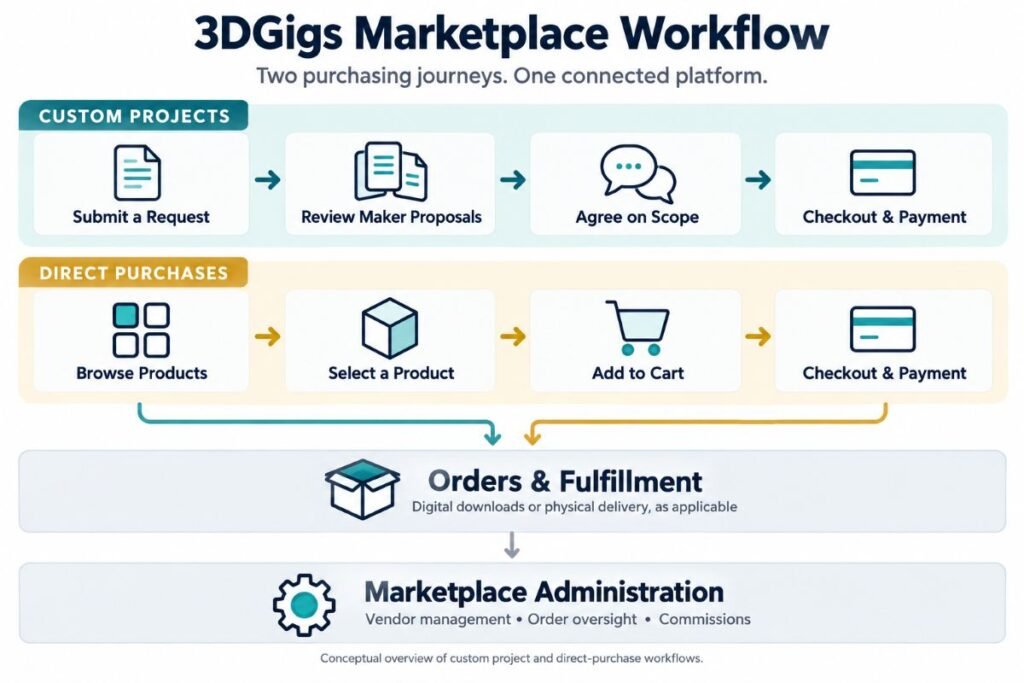
llustrative overview of custom project and direct-purchase workflows
3DGigs brings several distinct capabilities into one operating platform.
At a high level, the architecture connects:
Buyers and Makers → Project Requests and Product Listings → Proposals and Communication → Checkout and Payments → Orders and Fulfillment
Each component plays an important role.
Buyer and maker accounts establish different user experiences and permissions.
Project request workflows provide a structured way to manage custom services.
Product listings support direct ecommerce transactions.
Proposal and communication capabilities allow buyers and service providers to agree on the work before purchasing.
Payment and order workflows connect commercial activity with the appropriate marketplace participants.
Administrative functionality supports the operational needs of running a multi-vendor platform.
The value lies in how these components work together, rather than any individual feature in isolation.
Results: A Functional Multi-Vendor Marketplace
The development resulted in a functioning marketplace with interconnected buyer, maker, project, and transaction workflows.
Key capabilities delivered include:
- A working buyer–maker marketplace: Separate user experiences support customers seeking services and makers offering them.
- Custom project submissions: Buyers can request specialized modeling, prototyping, and manufacturing work.
- Proposal-based purchasing: Makers can respond to requests and discuss project-specific requirements with buyers.
- Connected ecommerce transactions: The marketplace supports checkout and payments for applicable custom work and listed products.
- Digital and physical product commerce: Makers can offer both downloadable design-related products and physical merchandise.
- Marketplace administration: Operational functionality supports vendor activities, orders, and the platform’s commercial workflows.
- An extensible platform foundation: Standard commerce capabilities were combined with tailored functionality to support the business model.
The platform has progressed beyond a static prototype to supporting actual marketplace transactions and operational workflows.
For prospective customers evaluating a development partner, the key takeaway is the breadth of functionality involved: user roles, specialized requests, proposals, payment integrations, product management, and administrative operations working together in a live application.
Planning a Marketplace or SaaS Platform of Your Own?
Building a marketplace requires more than selecting a theme or installing ecommerce software.
You need to define how users interact, where transactions happen, what information must move between systems, and which functionality is essential for the first usable release.
AZ Technologies helps businesses plan and build marketplaces, customer portals, SaaS MVPs, and custom web platforms around their actual business workflows.
Whether your idea involves connecting buyers and sellers, managing custom service requests, introducing subscription features, or creating a new digital product, we can help translate the requirements into a practical technical approach.
Request a Consultation or tell us about your platform idea.
What Other Businesses Can Learn From This Marketplace Project
Although 3DGigs serves the 3D modeling and manufacturing market, many of its technical challenges apply to other industries.
Service Marketplaces
Platforms connecting customers with contractors, consultants, or specialized service providers often need custom requests, proposals, communication, and payment workflows.
B2B Procurement Platforms
Businesses sourcing specialized goods or services may need request-for-quotation workflows, supplier responses, approval steps, and order management.
Membership and Subscription Platforms
Products that serve different user groups may require role-based dashboards, differentiated access, paid plans, and account management.
Custom Ecommerce Platforms
Businesses selling configurable products or made-to-order services may need workflows that extend beyond a fixed-price shopping cart.
The lesson is that a product’s underlying workflow should guide its technical architecture—not the other way around.
How AZ Technologies Can Help Build Your Platform
AZ Technologies provides technical consulting and implementation support for businesses developing or improving digital platforms.
Our capabilities include:
- SaaS MVP and Web Platform Development
- Marketplace and multi-vendor platform architecture
- WordPress and WooCommerce development
- Custom buyer, seller, and customer portals
- RFQ, proposal, and quotation workflows
- Ecommerce checkout and payment integrations
- Systems Integration and API Architecture
- Product requirements, technical planning, and implementation support
Our approach starts with the business model and the user experience, then identifies the right technology and level of custom development to support them.
Have a marketplace idea or an existing platform that needs improvement? Contact AZ Technologies to discuss your project.